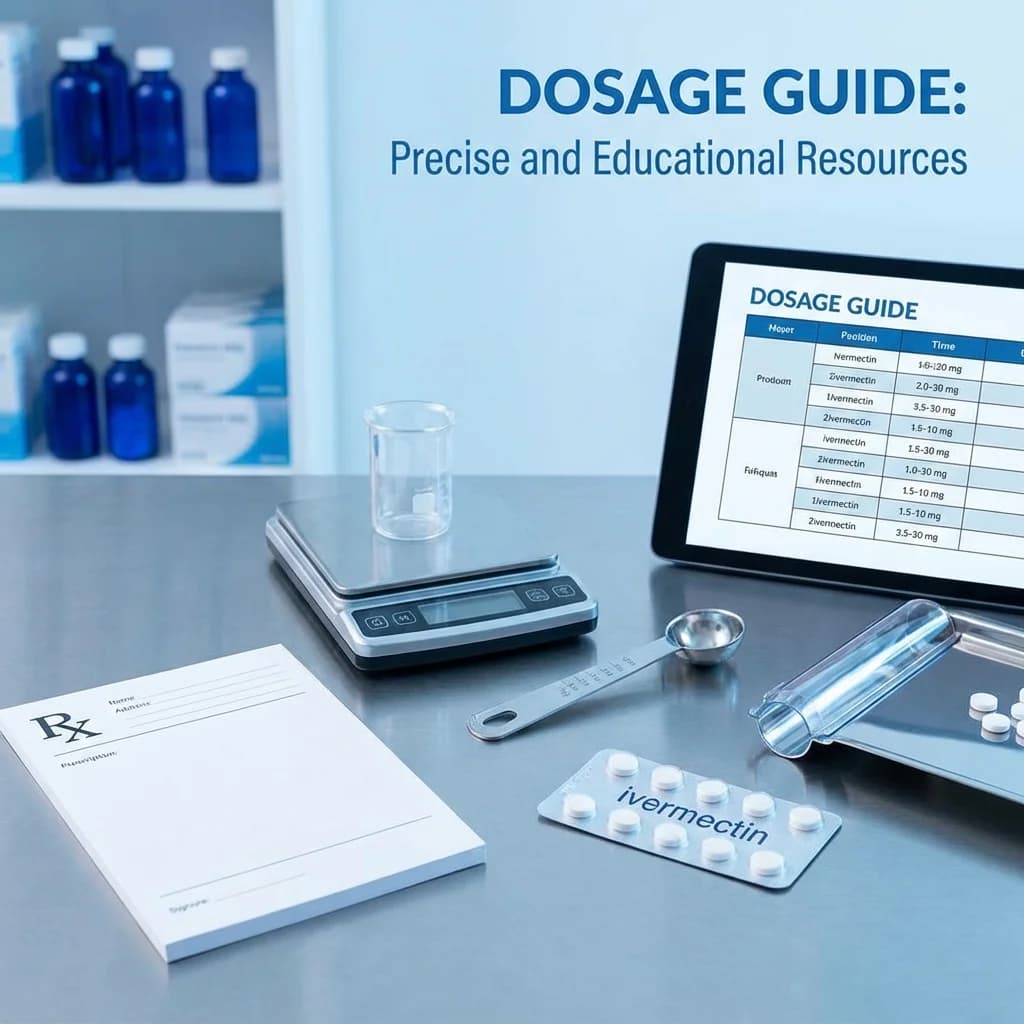
Proper dosing of ivermectin is key for its safety and to work well. This guide gives charts for doses based on weight and detailed steps for giving the medicine for all FDA-approved uses.
We have information about the correct amount to give. For weights over or equal to 80 kg, use the calculation: (weight in kg times 0.2 mg) to find the total dose. For weights over or equal to 85 kg, use: (weight in kg times 0.15 mg).
For example, a 70 kg adult with strongyloidiasis:
- Calculation: 70 kg times 200 mg/kg equals 14,000 mg, which is 14 mg.
- Tablets needed: 14 mg divided by 3 mg per tablet equals about 4.7 tablets, so round to 5 tablets for 15 mg total.
Another example, a 90 kg adult with onchocerciasis:
- Calculation: 90 kg times 150 mg/kg equals 13,500 mg, or 13.5 mg.
- Tablets needed: 13.5 mg divided by 3 mg per tablet equals 4.5 tablets, so round to 5 tablets for 15 mg.
The best way to take ivermectin is on an empty stomach with a full glass of water. Taking it this way helps your body absorb more of the medicine and keeps the levels steady in your blood. It also helps make the medicine work best and keep things the same each time.
Avoid heavy meals, especially ones with high fat, dairy foods, and grapefruit juice around the time you take ivermectin. These can change how your body handles the medicine. Sometimes, for treating scabies, doctors may tell you to take it with food to boost absorption. Always follow your doctor’s instructions.
The usual dose for most infections is a single oral dose of 200 micrograms per kilogram of weight. Check your stool at 2 to 4 weeks after treatment. If you have a weak immune system, you might need to take doses every 2 weeks or monthly for long-term control. Close watch is very important.
A common plan is to give a dose of 150 micrograms per kilogram each year. People in areas with many cases may need to be treated for 10 to 15 years.
When parasites die, they can cause side effects called Mazzotti reactions. These are often mild or moderate and may include fever, itching, and swelling of lymph nodes. See our other guide for details.
Another plan is to give one dose of 200 micrograms per kilogram and repeat it after 1 to 2 weeks. Sometimes, topical medicines like permethrin are used too. In hard cases like crusted scabies, several doses may be needed on days 1, 2, 8, 9, and 15, along with skin treatments.
The right dose depends on age and weight. Children follow the same weight-based rules, but extra care is needed for very young children. Watch for side effects.
For pregnant women, ivermectin is a category C drug, which means it should only be used if needed, when the benefits outweigh the risks. Animal tests show possible risks. Breastfeeding women should discuss timing with their doctor. They might need to pump and throw away milk for 24 hours after doses.
Most people do not need dose changes if they have mild or moderate liver problems. Those with severe liver disease should use ivermectin carefully, with dose reduction if needed, and check their liver tests. Since the drug is processed by the liver, caution is advised.
People with kidney disease usually do not need special doses because very little of the drug passes into urine. It is safe even in those with chronic kidney disease. Dialysis patients usually get the same dose.
Certain medicines can raise ivermectin levels. These include some drugs and supplements. Also, drugs that ivermectin affects or interacts with should be monitored closely.
It is best to avoid alcohol when taking ivermectin, as it can increase drowsiness and dizziness.
If you miss a dose, talk to your doctor. Do not take a double dose to make up for a missed one. If you are on a schedule of repeated doses, take it as soon as you can if within 12 hours. If more time has passed, skip and go back to your usual plan. Always tell your doctor if you miss doses.
Side effects can be serious. Call emergency help if you experience severe dizziness, fainting, confusion, seizures, trouble breathing, fast heartbeat, or vision changes. Do not wait for symptoms to worsen.
Keep ivermectin out of reach of children. Never use medicine meant for animals, as it is much stronger. Always follow your doctor’s exact dose instructions. Do not change the dose without help.
Store the medicine at room temperature, between 68 and 77 degrees Fahrenheit. Keep it in its original bottle, away from light and moisture, and out of children’s reach.
- Always check the date before use.
- Do not use medicine that has expired.
- Throw out expired medicine properly through pharmacy take-back programs.
Ivermectin tablets can be split if they have a score line. Do not crush them unless your healthcare provider says to do so. Crushing may change how the medicine works and its effect.
The time to take medicine depends on your condition. Talk with your doctor for advice.
Never take more medicine than told.
Taking more than the amount prescribed:
- Does not make the medicine work better.
- Can cause serious side effects.
- May lead to dangerous health problems.
Always follow the dose your doctor gives.
Call your healthcare provider if:
- Your symptoms do not get better after treatment.
- You get new symptoms.
- You have serious side effects.
- You are unsure about how much to take.
- You miss a dose in a multi-dose plan.
Additional resources:
- Information on medical uses.
- Full safety details.
- What you need to know about this medicine.
Sources:
- FDA. (2024). Stromectel label info. U.S. Food and Drug Administration.
- Merck. (2026). Stromectol (Ivermectin) prescribing guide.
- Drugs.com. (2026). Ivermectin dose rules.
- Medscape. (2026). Ivermectin use, interactions.
- Mayo Clinic. (2026). How to take Ivermectin.
Last update: January 17, 2026.
Author: Dr. Sarah Chen, MD, expert in infectious diseases.
Reviewed by: Medical team.